
Recent years have brought companies a real surge of new solutions – not only in tools and technologies. However, 2026 looks different: instead of another wave of novelty, we are seeing a clear shift towards consolidation, simpler architectures and more conscious use of technology where it genuinely supports business goals.
More and more organisations are no longer asking whether to invest in digital, but how to do it wisely – without unnecessary complexity and technical debt. At the centre of these changes is AI, not as a standalone add-on, but rather as a layer permeating data analytics, user experience design and software development.
AI as part of the entire ecosystem, not a single feature
In 2026, artificial intelligence is no longer seen solely as a tool supporting selected tasks. Increasingly, it is becoming an integral part of digital ecosystems – from analytics and conversion optimisation to automated operational decision-making. Analytics teams are observing a clear shift: from manual data analysis towards systems that interpret results themselves and suggest concrete actions.
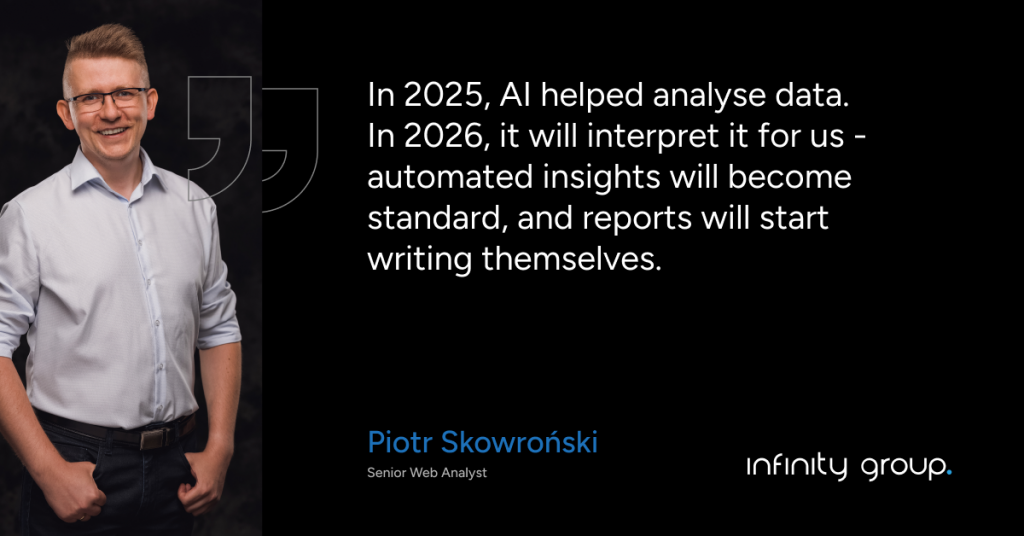
Real-time data increasingly also means real-time response – enabling automatic adjustments to marketing campaigns, UX variants or sales priorities.
Systems no longer just measure user behaviour—they increasingly trigger actions themselves: changing UX, switching off ineffective ads or optimising conversion paths.
Piotr Skowroński, Senior Web Analyst
AI-driven CRO solutions, algorithm-led multivariate testing and UX diagnostic tools that can automatically identify potential interface issues are also gaining traction.
Business analysis: fewer documents, better decisions
While the role of business analysis remains crucial, the way analysts work is evolving. AI increasingly supports them in organising information, identifying dependencies and preparing initial solution variants. This does not mean a revolution in the foundations of the discipline – rather a gradual evolution of tools.
Business analysis standards haven’t fundamentally changed. What we’re seeing is an attempt to adapt AI tools to everyday work—to reach conclusions faster and support decision-making more effectively.
Paweł Drągowski, Business Analyst
In practice, this means shorter discovery phases, better-prepared backlogs and a stronger focus on business context – exactly the areas that cannot be fully automated.
UX in 2026: faster validation, better product decisions
A similar shift is happening in user experience design. After a period of intense experimentation with AI tools, UX teams are now integrating them more deliberately into product development – especially at the early concept stage.
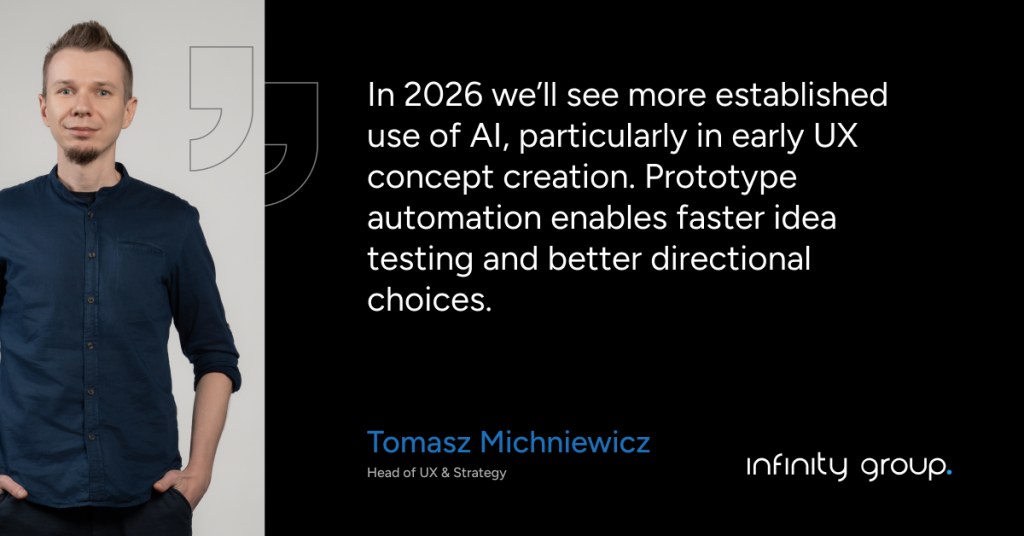
The result is simple: fewer costly iterations, faster hypothesis validation and a greater chance that solutions genuinely meet user needs.
Frontend and backend: mature stacks instead of technological patchwork
In 2026, development increasingly moves away from assembling applications from randomly chosen libraries. On both backend and frontend, there is a clear shift towards coherent ecosystems, simplified architectures and deeper AI integration. For businesses, this means less technological improvisation and greater predictability in digital product development.
Backend: infrastructure as code and AI readiness
In 2026, the backend increasingly serves as the foundation of the entire digital ecosystem. This is where decisions about scalability, security and readiness for further automation are made. Companies are moving away from extensive monoliths towards modular architectures that are easier to integrate with other systems and AI-based services.
The importance of infrastructure defined as code and new approaches to data – including semantic search – is growing, enabling more intelligent business features. Tool selection is becoming more deliberate, focused on avoiding costly vendor lock-in and maintaining architectural flexibility in the long term.
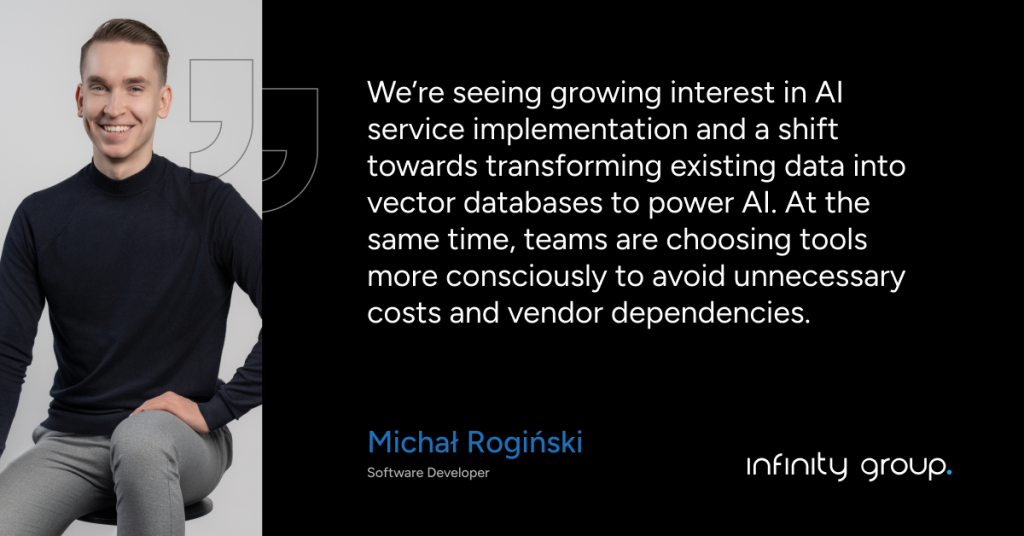
From a business perspective, this translates into more stable production environments, easier system integration and faster deployment of data- and AI-driven features.
Frontend: framework consolidation and a focus on performance
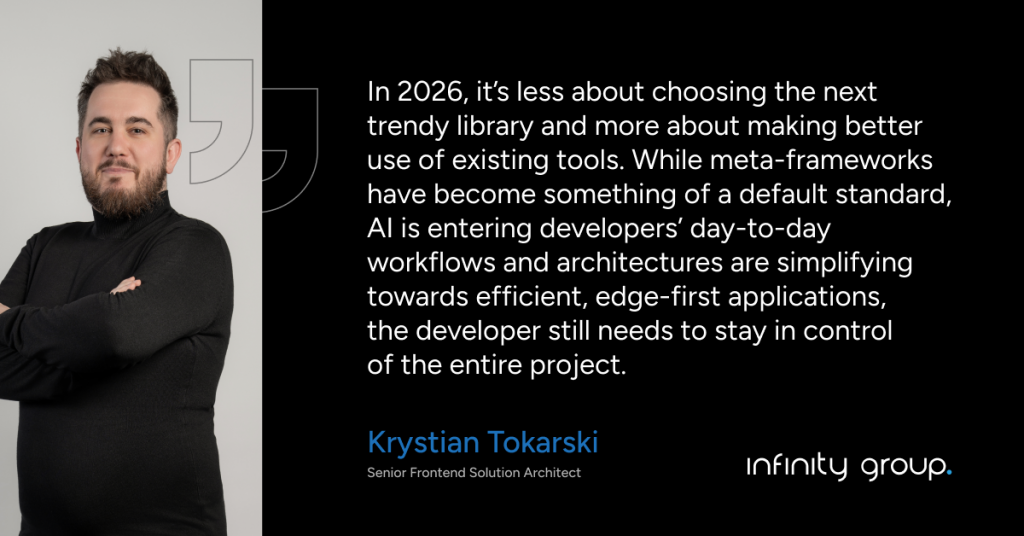
On the frontend side, 2026 brings clear market consolidation. Meta-frameworks (such as Next.js, Nuxt and SvelteKit) are becoming the default choice, as they combine routing, rendering, data layers and often authorisation within a single cohesive ecosystem. At the same time, there is still room for alternative tools such as Marko, Astro or Qwik, which accelerate the development of web applications.
In parallel, edge computing and WebAssembly continue to gain importance, allowing parts of application logic to move closer to users, reducing latency and improving responsiveness. Developer workflow automation is also playing an increasingly significant role – AI supports component generation, testing, refactoring and code reviews, becoming an integral part of the development pipeline.
We also observe a shift towards simpler architectures: growing interest in progressive enhancement, solutions like htmx and web components shows that teams are consciously limiting unnecessary complexity where it is not required. Moreover, thanks to the rapid evolution of Node.js and the availability of headless CMS platforms (such as Strapi), it is increasingly realistic for a single competency to deliver an entire website end to end.
Mobile 2026: pragmatism over ideology
For mobile, 2026 is a time of intensive exploration of solutions that enable faster delivery of high-quality applications across multiple platforms – without compromising performance or user experience. Companies are increasingly combining pragmatism with technological flexibility, choosing stacks based on project characteristics, from rapid MVPs to long-term, complex systems.
Compared to 2025, when multiplatform approaches were still maturing, today we see a clear shift towards integrative strategies. Mobile technologies are no longer competing – instead, they enable shared business logic, data and AI integration while maintaining native-quality interfaces. On-device AI and consistent, modern UI solutions are also gaining importance, opening up new possibilities for personalisation and offline work.
In this context, Kotlin Multiplatform Mobile is developing particularly dynamically, moving from “worth considering” to “the most cost-effective choice” for long-term projects.
Kotlin Multiplatform Mobile is becoming the most cost-effective choice for long-term and complex projects. It allows teams to freely share business logic and data across platforms, while still making it easy to introduce native components when needed. This approach shortens development time and reduces maintenance costs without compromising on native app quality.
Joanna Grzegorzczyk, Mobile Team Leader
Combined with Compose Multiplatform, KMM also enables UI layer scaling – shared where it makes business sense and native where more advanced UX is required. For organisations, this means faster delivery, greater product development flexibility and full readiness for AI integration as a natural part of modern mobile applications.
Intelligent test automation and the growing importance of security
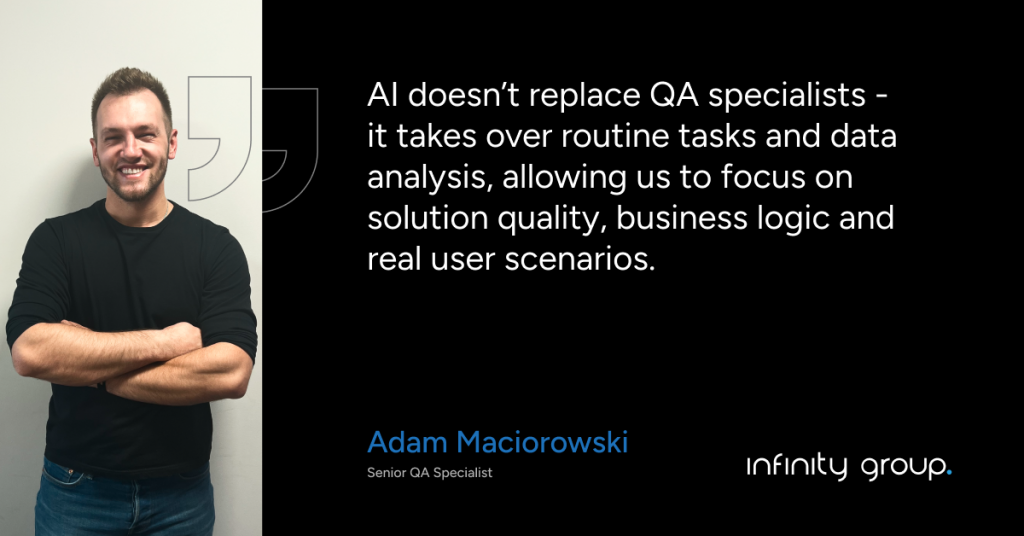
Quality Assurance (QA) is an integral part of software development, and what clearly changes in 2026 is the scale of automation and the rising importance of cybersecurity. AI increasingly supports QA teams with repetitive tasks such as log analysis, test case generation and regression detection. It does not replace specialists – instead, it allows them to focus on solution quality, business logic and real user scenarios.
At the same time, test automation remains a key area of development – tools like Playwright are increasingly becoming the standard for end-to-end testing, supporting fast release cycles without compromising quality.
Greater emphasis is also placed on application and infrastructure security. With the growing number of threats, cybersecurity skills are becoming one of the most sought-after areas, and security by design is treated as a natural part of the product design process.
What does this mean for businesses in practice?
A holistic view of these areas confirms that 2026 is not a moment of technological revolution, but rather a phase of consolidation and maturity for digital ecosystems. Companies are increasingly focused on how to connect tools and competencies into a coherent whole, rather than implementing isolated point solutions.
From the perspective of organisations planning digital product development, several key conclusions emerge:
- Technology should support business decisions – not the other way around. Understanding processes, data and real user needs is crucial.
- AI is moving from experimentation to operational use – supporting analytics, development, UX and QA, but requiring clear implementation and usage frameworks.
- Architectural simplicity increasingly wins over tool and framework overload, while systems become more deeply integrated.
- Multiplatform approaches and code reusability translate into real time and cost savings.
- Data, quality and security form the foundation of scalable solutions.
What matters most, therefore, is not following individual trends, but building a long-term digital development strategy – one that considers both business needs and team technological capabilities. It is at this stage – planning and prioritisation – that decisions are made which most strongly determine project success.
From trends to business decisions: the role of a technology partner
In this context, the role of a partner who can connect business and technology perspectives – and translate trends into concrete project decisions – is becoming increasingly important. At Infinity Group, we start by organising the fundamentals through our Discovery process. We break planned implementations down into first principles: from business analysis and stakeholder workshops, through UX design, to architectural recommendations and a product development roadmap. This ensures that technology becomes a conscious choice, not a starting point.
This approach helps to:
- reduce the risk of costly changes at later project stages,
- clearly define scope, priorities and delivery phases,
- select technologies aligned with business scale and ambitions,
- move faster from concept to development.
For over 25 years, we have supported companies in digital transformation – from websites and e-commerce to corporate systems and mobile applications. Working interdisciplinarily (analytics, UX, development, QA and data analytics), we help clients build solutions that genuinely increase operational efficiency and competitive advantage.
Summary
For many organisations, 2026 marks a time of consolidating digital ecosystems and moving from isolated initiatives to coherent product strategies. Technologies themselves matter less than how they are applied in the context of real business goals.
If you are planning the development or modernisation of your digital solutions, we would be happy to discuss your needs and possible directions – from analysis and design through to implementation and ongoing development.