
Off-the-shelf systems are often the best choice at the beginning of a company’s digital journey. They enable organisations to launch essential functionality quickly, benefit from proven mechanisms and keep initial costs under control. In many standardised areas – such as HR, accounting or basic sales operations – there is simply no need to build a system from scratch.
Over time, however, circumstances may change. The business grows, handles increasing volumes of customers and data, develops its own operating model, and its teams require new integrations and automation. As a result, a system that was once well suited to the organisation may gradually become too restrictive. Employees begin working around its limitations with spreadsheets, emails and manual processes, while licensing and modification costs continue to rise. This is the point at which it is worth asking whether further investment in the off-the-shelf solution can still be justified from a business perspective.
| Important! A bespoke system is not inherently the better option. The decision should be driven by processes, requirements, scale and the system’s total cost of ownership over several years – not by technology trends or attachment to an existing tool. |
The business problem: when the system begins dictating how the company operates
Virtually every organisation needs digital tools, but not every process can be accommodated within the same framework. Where hundreds of businesses operate in broadly the same way, an off-the-shelf product may provide exactly what is required. Its vendor develops a single product for many customers, giving each company access to ready-made features, updates and support without requiring it to bear the full cost of building the platform.
The situation is different in areas that underpin an organisation’’’s competitive advantage: non-standard order, delivery, contract, production, business partner, complaint or document workflow processes. The more distinctive a company’s operating model, the harder it becomes to find a universal tool capable of reflecting it without compromise.
The organisation then faces a choice: adapt the process to the tool’s logic, continue extending the standard system through further modifications, or create a solution aligned with how people actually work. This is not merely an IT decision. Its consequences affect operational employees, managers, finance, security and compliance teams – and, ultimately, customers as well. A poorly matched system can slow down the entire organisation even if, from a technical standpoint, it still „works”.
When does an off-the-shelf solution become a constraint?
A single inconvenience does not yet justify building a proprietary application. If several of the following issues occur simultaneously, however, and become more pronounced as the organisation grows, it is worth analysing the available options.
Licensing costs are rising faster than the value delivered by the system
With SaaS solutions, costs often depend on the number of users, the required functionality, data volumes or transaction numbers. As the business grows, it may need to purchase additional licences or move to a higher-tier plan merely to unlock a single feature, increase an API limit or obtain more data storage. The subscription fee alone does not reveal the full picture. The total cost must also include configuration, integrations, paid extensions, custom development, training, migration and the time employees spend working around the system’s limitations. Sometimes the most expensive element is the one that never appears on the price list.
The system does not support the company’s key processes
If part of the work takes place in the application, part in spreadsheets, and the remainder in inboxes and the memories of the most experienced employees, the tool is no longer a shared environment for managing the process. A parallel, informal version emerges – one that is harder to control, measure and improve.
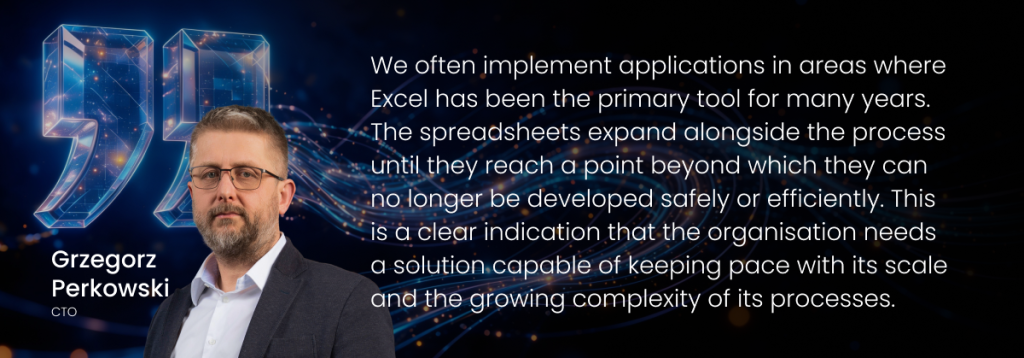
Excel files that have been expanded over many years are a particularly common warning sign. They may initially serve their purpose well, but as the number of users, dependencies and data increases, they eventually reach their limits. At some point, the spreadsheet becomes a system – despite never having been designed as one.
Integrations are becoming more numerous and complex
Modern solutions exchange data with ERP and CRM systems, e-commerce platforms, warehouses, payment services, data warehouses and partners’ tools. Ready-made connectors are a major advantage of off-the-shelf software – as long as they meet the organisation’s actual needs.
Problems arise when API access requires a more expensive licence, call volumes are restricted, the available data proves insufficient, or the process requires non-standard orchestration across multiple systems. A bespoke solution offers greater freedom in designing the integration layer, although the cost of building and maintaining it must also be taken into account.
Data must remain within the organisation’s own environment
Security policies, contractual requirements, industry regulations or the organisation’s risk-management model may require data to be stored and processed on its own infrastructure or within a strictly defined cloud environment. Not every SaaS platform offers the required deployment model, data location, level of control or ability to comply with internal standards. Although this does not automatically mean that a proprietary system must be built, it is an important criterion that can significantly narrow the range of suitable products.
Extensive customisation is required
Modifying a ready-made platform can be a sensible compromise. It is important, however, to identify the point at which the organisation is no longer paying for the product itself, but for continually working around its architecture. The further the modifications depart from the standard version, the more difficult upgrades and transitions to subsequent releases may become.
Paradoxically, extensive customisation can also increase vendor dependency. The company continues to pay licence fees while also requiring specialists familiar with its particular extensions and the way they have been connected to the platform.
A global product does not reflect local realities
A system designed for numerous markets will not always account for requirements specific to Poland, particularly in accounting, fiscal matters, taxation, data protection or electronic document workflows. Adapting a global model to local regulations may require numerous extensions and, in extreme cases, reveal that the product’s underlying logic is fundamentally incompatible with the organisation’s needs.
What happens when a company remains with a poorly suited system for too long?
Rising licence fees are relatively easy to identify. It is far more difficult to calculate the time lost each day to copying data, checking several sources, resolving errors and carefully managing exceptions. Multiplied by the number of employees and months, however, these activities create a very tangible operating cost. A poorly matched tool may lead to:
- manual re-entry of information and a greater number of errors,
- parallel data sources and difficulty identifying the latest version,
- longer processing times for orders, contracts, deliveries or requests,
- more difficult reporting and decisions based on incomplete data,
- lower employee productivity and satisfaction,
- limited opportunities to introduce automation and AI,
- higher costs for licences, extensions and integration maintenance,
- an increasingly difficult migration in the future.
The apparently quickest route may therefore result in mounting process and technical debt. Instead of designing future activities around business needs, the organisation plans them within the limits of what the system provides out of the box. Introducing additional modules may also force a sudden change in working practices and leave users confused if it is not preceded by proper analysis and change management.
When does a bespoke solution make business sense?
The right time comes when the business case shows that a proprietary solution could deliver greater value than continuing to maintain, license and modify the off-the-shelf system.
In some cases, a comprehensive platform such as Microsoft Dynamics, offering an extensive range of ready-made features and integrations, will be the best solution. If its implementation requires a large number of licences, extensive customisation and the adaptation of key processes to the platform’s logic, however, it is worth comparing this scenario with building a bespoke system. Only a comparison of the full implementation and maintenance costs will reveal which option offers better value in the long term.
Such an assessment should cover several years rather than merely the cost of launching the first version. It should account for licences, implementation, integrations, data migration, maintenance, upgrades, security, training, access to specialists and the cost of downtime. The potential value is equally important: employee time saved, fewer errors, faster customer service, the ability to scale the process, or the opportunity to launch a new business model.
What are the benefits of a bespoke solution?
The greatest advantage of a bespoke system is that it can be designed around the organisation’s actual processes, roles and objectives. There is no need to build an entire platform at once. Development can be evolutionary: beginning with an MVP that supports the most important part of the process, continuing through successive releases delivered in line with a roadmap, and ultimately replacing existing tools in stages. This approach can provide:
- an application tailored to the organisation and its individual user groups,
- greater freedom to develop the solution and add new functionality,
- full rights to the source code, depending on the contractual arrangements,
- no licence fees for the application itself, although infrastructure, development and maintenance costs still apply,
- the ability to design an efficient integration layer,
- greater control over data storage and the security model,
- easier integration of automation and AI agents into clearly defined processes.
One example might be an on-premises AI agent that analyses messages and attachments, identifies the type of case, creates tasks and assigns them to the appropriate people. In a bespoke system, this mechanism can be embedded directly within the process and connected to the organisation’s existing rules, permissions and data sources.
Bespoke solutions also involve risk
Building a proprietary application is not a shortcut. It generally requires a larger initial investment, and the first version may take longer to launch than a ready-made product. It does not automatically provide a catalogue of pre-built integrations; each one must be designed, implemented and tested. The organisation must also plan for:
- application maintenance, monitoring and development,
- technology upgrades and the management of technical debt,
- security, backups and business continuity,
- documentation and knowledge transfer,
- access to a team capable of developing the system,
- the delivery time for minor changes, which will not always be shorter than on a no-code or low-code platform.
There is also a risk of becoming dependent on a single supplier. This can be reduced by securing rights to the source code, technical documentation, automated tests, agreed architectural standards and a formal handover procedure. In practice, „vendor independence” does not arise from the type of system alone; it depends on the contractual terms, the quality of the documentation and the way the project is managed.
How should the decision be made? A step-by-step process
The choice between continuing to develop an off-the-shelf system and building a bespoke solution should be based on analysis rather than intuition. The following steps will help the organisation structure its needs, assess the available options and determine which approach has the strongest business rationale.
Define the scale
Gather data on the number of users, roles, transactions, orders, documents and integrations, as well as the volume of information stored. Consider projected growth over the coming years too. Without this information, it is difficult to compare costs and performance reliably.
Map the current process
Describe how work is carried out today, including everything that happens outside the official system. Take account of spreadsheets, messages, manual approvals, exceptions, duplicate data entry and points at which the process stalls. Distinguish genuine business requirements from habits created by the existing tool.
Define the problem and establish success metrics
Specify what needs to change. The objective might be to shorten processing times, reduce errors, lower licensing costs, automate a defined percentage of cases, or increase process capacity without expanding the team. These metrics should be established before any technology is selected.
Conduct business and functional discovery
The objectives, users, rules, data and process dependencies must first be understood; only then should functionality and architecture be designed. Starting with a predetermined technology creates the risk of building a system that solves the wrong problem perfectly.
Compare the options
Compare the costs and value of remaining with the current platform, implementing a different product and building a bespoke system. For each scenario, consider the solution’s entire lifecycle, migration risk, vendor dependency and capacity for future scaling.
Plan the MVP and roadmap
If the analysis supports a bespoke solution, select the part of the process that will deliver the greatest value and can be separated safely. The MVP should test the most important business assumptions rather than being an arbitrarily reduced version of the final system. Subsequent stages can be introduced gradually, reducing the risks associated with migrating everything at once.
Establish the maintenance model
Before work begins, decide who will be responsible for monitoring, user support, security, development and technology upgrades. Assess whether the organisation has the necessary expertise in-house or whether maintenance should be entrusted to a partner.
What does this look like in practice?
One of our clients faced a choice between an off-the-shelf Carrier Management System designed for global processes and a solution tailored to its own delivery management model. The standard product would have required extensive adaptation, while some of its underlying assumptions did not reflect users’ day-to-day work.
After analysing its processes and requirements, the client chose a bespoke system. The solution was designed around the actual delivery management process and the needs of specific user groups, while taking account of the required integrations and scope for future development. As a result, the technology supports the process instead of forcing the organisation to conform to the logic of a universal product.
Conclusion: it is not a choice between a „good” and a „bad” system
An off-the-shelf solution may be the optimal choice when the process is standard, its existing features cover most requirements, and licensing costs remain proportionate to the value delivered. A bespoke system gains the advantage when a distinctive process is strategically important, the organisation’s scale and integration requirements exceed the product’s limitations, or further customisation becomes more expensive and risky than building an application around the organisation’s needs.
The first step, therefore, should not be choosing the technology, but conducting a thorough business and functional analysis. At Infinity Group, we help organisations map their processes, assess the available options and build a business case before designing and developing a solution in a model tailored to their needs. If your current system is increasingly restricting growth rather than enabling it, let us discuss what genuinely needs to change – and whether a bespoke solution can be justified in your particular case.
